
One Salesperson Quadrupled Her Sponsorship Sales
Marissa Lovell's From Boise has 25,650 subscribers and $97,572 in revenue so far this year, almost all sponsors. She explains how a 22-year-old contractor changed her sales, and how Dinner Club sells out.
 TJ LarkinHost, Local Media HQ PodcastJune 30, 2026 · 10 min read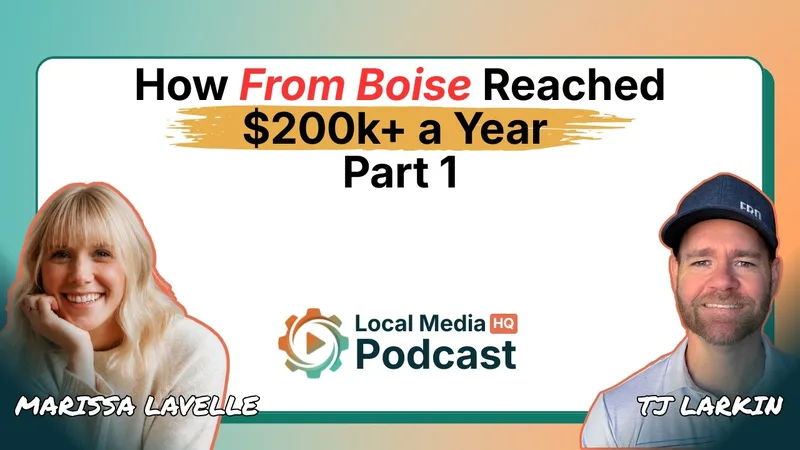
- Sponsorships pay the bills. Of Marissa's $97,572 so far this year, about $88,000 is sponsorships. Events, reader donations, a Shopify product and a newspaper that republishes her stories make up the rest.
- One sales hire quadrupled sales. Marissa made up to $80,000 a year on her own, but it was a grind. Leslie, a contractor she brought on in May 2025, quadrupled sales from Q1 to Q2 by meeting sponsors in person.
- Onboarding made it work. Leslie got Marissa's full inbox, a Notion page of everything she knew, a two-month grace period, and then real trust. Marissa stays off sales calls unless Leslie asks.
- Start selling on day one. Marissa made about $100 her first year and wishes she had asked for sponsors before the first issue. Her view: 200 subscribers is enough attention for a small local business.
Marissa Lovell runs From Boise, a newsletter about the people, places, history and events of Boise, Idaho. Five years in, she has 25,650 subscribers, more than 40,000 Instagram followers, and a goal of $250,000 in revenue this year. Almost all of it comes from sponsors. In this first of two parts she tells me why she was stuck for years, what changed when she hired one salesperson, and how a monthly Dinner Club turned readers into a community. Part 2 covers her Instagram growth and what she changed about the events.
A tweet from Nathan Barry started it
Marissa was doing PR for a music festival in Boise and trying to start a live music blog. Then her old boss from a previous PR agency sent her a tweet from Nathan Barry of Kit. Nathan wanted someone to take his idea for a local newsletter and run with it, because he had the idea but not the time. Marissa filled out the application and basically told him she was doing it, so when could they meet?
She knew nothing about newsletters but saw right away that one beat a blog. Nathan showed her the basics of getting subscribers. It didn't really click until she was two years in. She didn't care much yet, and it was a fun side project next to her day job.
What changed her mind was Craft and Commerce, Kit's conference in Boise. Nathan told her she should come. She saw people on stage making millions with newsletters and realized this was a business, not a hobby.
What From Boise earns, and from what
The newsletter goes out Tuesdays and Thursdays. Tuesday is a long story of 1,500 to 2,000 words, usually a profile of a person, a place, a piece of history or an event. Thursday is a huge curated list of things to do over the weekend.
Most of the rest is events and reader donations. She also sells a physical product on Shopify, and a local newspaper republishes her stories for a fee per story. Subscribers grow by 500 to 800 a month, and she wants that number higher.
She keeps the business tight. Everything is tied to the media brand and the community, with no digital agency or AI services on the back end. All her sponsors are local, with only two or three this year that aren't, and those are still locally relevant. Most of the sales are cold outreach, though more is starting to come in.
Five years, $100 and a grind
Marissa made about $100 in her first year. She didn't think she had enough subscribers to ask for ad money, and she now wishes she had reached out from day one, before the first issue. If you have 200 people on your list, she says, you have the attention of 200 people, and that matters to a small local business.
She had another job and treated it as a fun project, which she now calls a stupid way to think about it. The most she made without help was $80,000 in a year, and it was a grind. She was doing nearly all the content, with one person on social and a few freelancers. Some weeks she was far ahead on stories and had no sponsors. Other weeks she had sponsors and a story due in four hours.
The hire that changed it
Marissa had a baby in October 2024. She was worried about keeping the content going, and by February 2025 she had no sponsors lined up. She had been the one meant to sell, and she was home with a newborn. She says she basically ran out of money and wishes she had hired sooner.
She knew Leslie from social media marketing work. Leslie was finishing college, and over coffee she said she thought she wanted to do sales instead of marketing. Marissa asked if she wanted a job. Leslie started right at the beginning of May 2025, and Marissa says she quadrupled sales from Q1 to Q2.
- 01Share everything
A Notion page covering how she had done sales, every email she had sent, and access to her inbox, including leads she never followed up on
- 02Give her a grace period
$1,000 a month with no commission for the first two months, while Leslie built her pipeline
- 03Switch to real pay
$500 a month base plus 25% commission once she closed about three deals
- 04Pay for the tools
Marissa told her to make whatever she needed, like a new media kit and a Calendly, and bill her
- 05Stay out of the way
Marissa joins sales calls only if Leslie asks
Leslie hit the commission threshold in month two. In month one she contacted about 200 people. Her biggest month so far was $8,000, which Marissa notes is good money at 22. She now handles social media too.
Why Leslie works in person
Marissa looks for someone who understands marketing and brand, both hers and her sponsors'. Leslie's own Instagram showed it right away. Leslie also wants to go to networking events, influencer events and restaurant and cafe openings, and she follows up right away. Her note says something like, it was so nice to meet you last night, we reach over 80,000 people in the Treasure Valley every week across our channels, and here is how we can get your opening in front of them. A message like that is hard to ignore.
Leslie writes every email by hand and doesn't use AI. Marissa says AI cold pitches do work if you lack the time or the budget. But for a hyper-local newsletter, she thinks a person who wants to meet people and follow up is a huge advantage.
Her tip for finding someone: Leslie was in the sales club at Boise State, so if your town has a university, start there. Those students want a foot in the door. And as a contractor, Leslie doesn't need a salary.
Giving up the sales calls
For Marissa the hard part was trust. The brand voice is her own personality, and she calls it her baby.
It's very difficult to give someone full trust to represent your brand, but it's so important because you hold that person back if you're just micromanaging them and nitpicking them.
She is not on sales calls unless Leslie asks, such as when she has the connection or the pitch is a big idea outside the normal scope. The handoff has also changed. At first Leslie made the sale and passed it to Marissa, who wrote the sponsor copy in the newsletter's voice and went back and forth with the client. Now Marissa uploads the finished folder to Notion, which pings Leslie. Leslie makes the social content, adds the link to the story in the Google doc, and sends it to the client. Edits go to Leslie, who only calls Marissa for a rewrite.
Leslie then handles everything after that. That includes check-ins on multi-month deals and a recap she designs in Canva called an impact report. She uses it to pitch the next thing.
Marissa also had to change how she saw herself. She had to move from "I'm just a writer with a newsletter" to "I'm a CEO building a business," and she says that took about a year.
What she cut, and how she sells
Having a kid made it obvious what mattered. Marissa had been juggling a newsletter, social media, a podcast, events, shirts, hats, stickers and pop-ups. She scrapped the podcast and stopped pushing products. When she hired Leslie in 2025 she decided sponsorships were the most important revenue stream, and that sponsors should have the best experience from start to finish. Once she did that, everything changed. Her advice is to make one thing the best it can be before adding the next.
Most sponsorships are multi-month or year-long packages with several newsletter ads and what she calls social media activations. They are made for Instagram, then posted to Facebook and TikTok, in that order of importance. She also sells Instagram story sets of two or three slides. Sponsored stories on the Tuesday newsletter are the most expensive and only offered when it's something she would write about anyway. Dinner Club is sponsored too.
She would like more annual sponsors, and she prefers being paid monthly because it is easier to plan around. She still does one-off ads for small nonprofits and businesses, because bigger annual sponsors cover those.
Dinner Club and 650 yeses
Marissa used to say she hated events. Then she saw Landon of Wichita Life run a dinner club, and people in a newsletter group she is in were talking about it. Her market has lots of newcomers, so in December she polled her readers. She told Leslie that if 100 people said yes they would try it. 650 said yes.
The first dinner in January had 96 people. They have run one a month since, and she did two in April. She is raising the cap from 120 to 150 because they sell out every time. So far Dinner Club has made about $8,000.
People fill out a short form about what they are like and what they are into. Six people are matched to a table. On the day they get a text with the restaurant and emojis for their tablemates, then another text during dinner about the after party.
What surprised her most is that the tables keep meeting up, going to happy hour or the lake. At the latest dinner, two groups from January and February were hugging hello. Another surprise was that every dinner has had someone who just moved to Boise. One couple from Florida signed up before they had even arrived, and their dinner was on a Monday and they moved that Thursday. Nothing was unpacked yet.
Questions people ask
Who is Marissa Lovell?
How did From Boise make money?
What changed when she hired a salesperson?
How does Dinner Club work?
TJ is the founder of Local Media HQ. Every week he talks with local media operators about what is actually working in their towns.