
Her carousel got 40,000 views. The reel got 9,000.
Marissa Lovell of From Boise on why one dinner a month beats two, how an automatic DM brings in thousands of subscribers, and why a faceless Instagram account works.
 TJ LarkinHost, Local Media HQ PodcastJuly 7, 2026 · 11 min read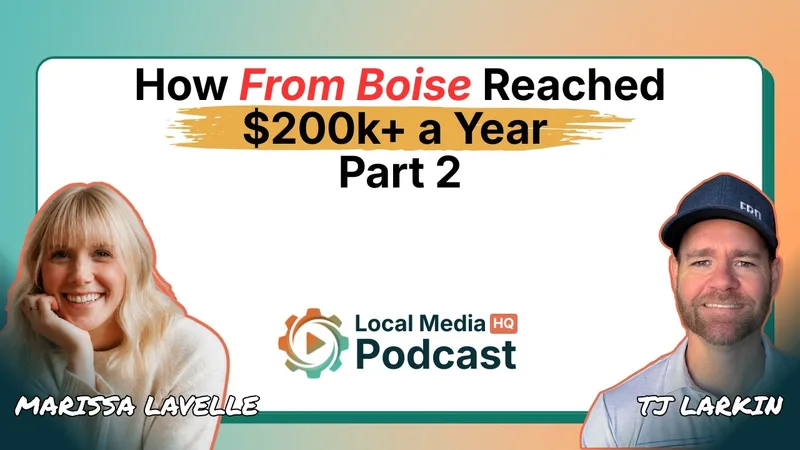
- One dinner a month feels like an event. Two dinners in one month "lost its sparkle." One keeps it special, and gives her a clear deadline to sell tickets against.
- Every post can capture a subscriber. A paid ManyChat plan for about $20 a month sends a DM to every new follower and every commenter. It has brought in thousands of subscribers.
- Carousels beat reels, for now. Same caption, same five events: the reel got about 9,000 views and the carousel almost 40,000, with more engagement.
- Faceless works because the quality is high. She stays out of the camera and lets the viewer see Boise through her eyes, while hiring people who make better posts than she could.
Marissa Lovell runs From Boise, a local newsletter and Instagram account in Boise, Idaho. This is part two of our conversation. If you missed it, part 1 covers her sponsorship revenue and her first sales hire. This half is about the day-to-day: how often to run the dinner club, how she turns Instagram followers into newsletter readers, why a carousel beat a reel by four to one, and why she never became the face of her own brand.
Why one dinner a month is enough
From Boise has also tried happy hour clubs, but the ticketing platform she uses isn't set up for events that aren't dinners, so she put those on pause. The bigger lesson came from running two dinners in one month, in April. They were good, she said, but they lost their sparkle. With one, it's "the dinner club of the month."
I made the point that one a month lets her hype it harder: if you miss this one, you wait another month. In May attendance was a little lower. She thinks part of that is that people are busy in the summer. The other part is that her team promoted that dinner less, because they had a lot of other things to push.
That led to a point we agree on. You hear every announcement because you wrote it. Your audience doesn't, and Instagram may not even show it to most of them that day. Marissa's test for how often to talk about something is simple: if it feels icky, you're not sure it's valuable. If you think it's cool and fun and people should come, say it again.
The dinner club feeds the newsletter
Marissa said there are people who find From Boise on social media, come to the dinner club, and then ask what the newsletter is. About 430 people have been to a dinner so far, with a lot of repeat guests. In her view the events build the list too, as long as you also talk about them on social media.
Her simplest ticket-selling trick takes about a minute. She checks how many tickets are left, then shares it to her stories with a link and a line like "50 seats left." She said every single time she does it they sell at least one ticket, usually four or five. She does it once or twice a week leading up to the event.
Her first hire was Instagram
Marissa doesn't enjoy social media. It takes her a long time and she isn't savvy at it, so for years someone else has run it. It was her first hire. But she has strong opinions about how the account should feel: everything has to flow together, look good and be clearly branded, and make you feel like you're living different lives around Boise.
She keeps what she called very high content standards across every platform. Her job is to sit in the creative director seat, give the idea and the goal of the post, and let the person create it. She said what Leslie sends back is better than what was in her head. Now Leslie sends ideas of her own and Marissa's answer is usually "yes, post it."
The account grew fast. A couple of years ago a few posts popped off and kept going. Now Instagram is a major source of newsletter subscribers.
ManyChat on every post
ManyChat is the tool behind that. Nearly everything From Boise posts has an automation attached. The two that matter:
- Comment to DM. On days the newsletter goes out, a post asks people to comment a word. ManyChat DMs them to ask if they're already subscribed or new. New readers send their email and get the story by email. Existing subscribers get the link in the DM.
- The new follower DM. When someone follows the account, they get a message: this is Marissa, we also have a newsletter, do you want it? Thousands of subscribers have come in that way.
She pays for ManyChat, about $20 a month, which she called nothing compared with the subscribers it brings in. She's heard that some people stay on the free plan and delete subscribers to stay under the limit. She doesn't have time for that. People can also ignore the DM, and some reply to say they've followed for all five years and finally found the Instagram.
Literally every single piece of content that we put out on social media has the ability to get a subscriber.
She recently hired a contractor who writes the Thursday newsletter and is also good at digital marketing. Marissa pays her the same amount every month to tinker with all of the marketing. The first thing she did was set up tags, so Marissa can log into Kit and see which ManyChat automation each subscriber came from. They can now run giveaways on stories, too. Someone comments on the story and still triggers the DM.
Carousels are beating reels right now
This is the part Marissa dislikes about social media: you have to keep up with stuff like this. Right before we recorded, carousels were crushing reels on the account. So Leslie posted both on a Thursday with the exact same caption. That's the weekly "things to do in Boise this week" post, with five items from the newsletter.
The reel got about 9,000 views. The carousel, which was just a picture of each event with a short branded description, got almost 40,000 views and more engagement. She doesn't know why. Other accounts have started doing the same weekend roundup reel, so she wonders if a carousel simply stands out now.
I'd heard something similar from one other person, who gets more than a thousand followers a month from news carousels. Their page is the same design every time with a different story on it.
Faceless, but very human
Marissa runs a largely faceless account. She's heard that it's better for a brand to have someone to connect to, and she agrees. But she thinks that's mostly an influencer account, and she doesn't want one. It also lets her post about anything, and she likes it as a POV account, with the coffee shops she works at and the events she goes to dropping the viewer into the moment.
I called it a first-person video game: you don't see the person, you see what they see. My take was that faceless usually fails because the quality is low. Hers works because the pictures and videos are high quality and show real things really happening. That's not what most people mean by faceless.
Marissa's advice is to pick what you'll keep doing. She wouldn't show up on social media every day to film herself, so it wouldn't happen. You know your community best and you know what you like doing best, so do both.
When she started, she was fine with people knowing her name, like an author, but not her face. That's loosened a little. She told her readers when she had a baby and would be away for a couple of months, and they replied to her newsletters wishing her well. Most of the time she still isn't recognized. At her own dinner clubs, someone will talk to her for ten minutes and then ask what restaurant she goes to. She tells them she's the organizer.
One morning TV spot brought 550 subscribers
Her PR background has paid off. When she started there was no local newsletter in Boise, so she called a friend who is a news anchor at Channel 7 and asked to come on. It was a morning slot, with a 4 a.m. wake-up, and it brought about 550 subscribers. She later pitched them the dinner club to come back on.
Her view is that local news stations like this kind of story. It's evergreen, happy and community focused, and she's not competing with them because she doesn't cover news. Her stories are history and people profiles. Using an MCP connected to Kit, her team recently looked at their most engaged subscribers, and all three TV news stations and one newspaper were on the list.
What's next for From Boise
Marissa wants to hire more people, which she says she didn't used to think. When early hires don't work out, it feels easier to do it yourself, and she lived there for a while. After some try-and-fail, she has figured out onboarding and hiring for the right jobs. It took so much off her plate that she's out of the content hamster wheel and has room to think about the future. Her words for what it takes: the right onboarding, plus being willing to give feedback and coach.
Specifically, she wants to hire an event person and do more than dinners:
- Different times of the day. People keep asking for brunch, and with a toddler she'd choose brunch over a 7 p.m. dinner.
- A "new to Boise" meetup. She plans to launch it in August and run it twice a year. Boise is one of the fastest growing metros in the country, and many people moving there don't know anyone.
- Silly ideas. A neighborhood cat tour, which she saw on Instagram and thinks is in Wisconsin. The organizer has run it for about seven years, with people registering their cats along a walking route.
- A flagship annual party and "From Boise field trips." The field trips would take a small group behind the scenes of something her team covers.
She's also thinking about a third newsletter edition about food. The reason it hasn't launched is that she wants it sponsored first, and a writer hired for every issue. In the past, she said, she'd have just done it that day.
How to test an event before you commit
Everything that works for her now took four or five tries. Before the dinner club she tried two different meetup clubs. She asked people for feedback or listened to how she felt about it, then tweaked it or scrapped it. The events that didn't work were the ones she didn't test with her audience first.
My favorite trick came from Justin Gordon, who has been on the show a bunch. He uses Luma and sets events to "apply to join." If not enough people apply, he cancels, and nobody was ever officially invited, so there's nothing to refund or retract. Marissa's version is lower tech: tell people you're not sure where this is going, say here's an idea, and ask what they think.
- 01Ask your audience first
Post the idea and see who responds before you sell anything.
- 02Say it's a test
Tell people you'll see how it goes and may change or stop it.
- 03Try "apply to join"
Luma can screen interest, so you can cancel without refunds.
- 04Keep what works
Tweak it or scrap it. Marissa's winners took four or five tries.
Questions people ask
How many dinner clubs per month does Marissa Lovell run?
How does ManyChat bring in newsletter subscribers?
Why are carousels beating reels at From Boise?
Why does From Boise run a faceless Instagram?
TJ is the founder of Local Media HQ. Every week he talks with local media operators about what is actually working in their towns.