
3,000 subscribers in a year with no Meta ads
Nick Roberts grew NoHo Nick in the San Fernando Valley to about 3,000 subscribers on TikTok, Instagram and Reddit, with an 84% open rate and his first ad revenue.
 TJ LarkinHost, Local Media HQ PodcastOctober 3, 2025 · 9 min read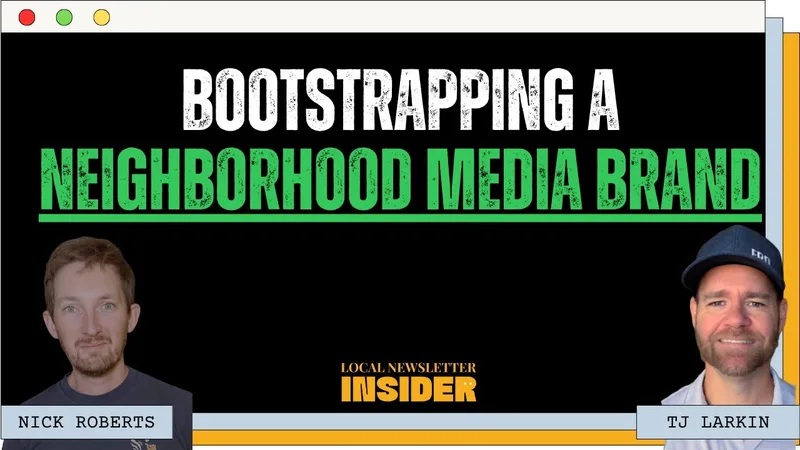
- No Meta ads, by choice. Nick treated organic growth as a challenge to himself. About a year in he was crossing 3,000 subscribers, and he hit 1,000 only two months earlier.
- TikTok first, Instagram second. He makes almost every video as a green screen over a screenshot of a local event, posts it on TikTok in minutes, and republishes the winner on Instagram.
- Say the same thing again. His biggest Instagram video is a 20-second "do you live in the San Fernando Valley?" selfie. Once a week he records a fresh version of it.
- The money is just starting. He broke even that week, with ads covering his Beehiiv bill and tools. Real estate agents are asking for a featured house spot, and he has no ad rate formula yet.
Nick Roberts lives in North Hollywood, and his wife used to joke that he was "NoHo Nick." He turned the joke into a newsletter, and a little over a year later he was about to cross 3,000 subscribers without paying for a single ad. We recorded this in October 2025. He talks about the TikTok workflow that gets a video up in minutes, why he repeats his best video every week, and what he's learning now that advertisers are showing up.
Why a newsletter about the Valley
Nick says LA already has plenty of media, but it covers "over the hill": Hollywood, Malibu, the places people think of as Los Angeles. The suburban side, the San Fernando Valley with its young families and professionals, was an empty space. He was always hunting for events and new restaurants himself.
The hip new LA restaurant gets covered. The local pizza shop or the local dentist did not.
Why he named it after himself
The name started as a joke, then stuck. Nick admits he "might have shot myself in the foot a little bit by branding it as myself," because the brand is now tied to him. But he is very present on social media, and he thinks having a face to go with the name helps when he goes out to events. He compares that with a name like "San Fernando Valley Buzz."
Bootstrapped on purpose
Nick has worked in startups for about 10 years, and he says the ethos at a lot of those companies was to be bootstrapped and profitable from day one. Skipping Meta ads started as a challenge to himself. He says it wasn't out of fear or a moral stand, and he's sure the ads work for plenty of people.
It was slow. He hit 1,000 subscribers about two months before we spoke, and 3,000 was expected that day. His growth comes from TikTok, Instagram and roughly 20% from Reddit.
In his first couple of weeks he stapled posters to lamp posts. The city took them down, and he figured that out pretty quickly. Next he shared his link on local subreddits. The big metro-area ones tend to delete links, but tiny subreddits of about 5,000 members for one neighborhood, plus a small Facebook group, built momentum. Things really turned once he started posting on TikTok and Instagram and shouting out local businesses.
TikTok first, then Instagram
Nick had been off social media for a couple of years. Once he started the newsletter, he decided that skipping the main distribution channels was a fool's errand. He started on TikTok because it was easier to create in, and TikTok overindexed compared with Instagram for him.
Almost every video is a green screen. He screenshots an event flyer or an Instagram post, puts it behind him in the app, and records. He says the background removal works almost flawlessly. He posts two or three times a day, and each video takes about five minutes.
Instagram started later as a republish channel. The video that did best on TikTok goes over there, and he invites the business to be a collaborator on the post.
- 01Scroll for 10 minutes
Instagram already shows him local events, so he favorites three or four and screenshots them.
- 02Record on TikTok
Green screen with the screenshot as the background. Captions go on automatically, plus a big headline banner.
- 03Wait for the winner
If he records three or four in a row, he waits until the end of the day to see which one got the most engagement.
- 04Republish on Instagram
He posts the winner there and invites the business as a collaborator. He also tags the location, which seems to help neighborhood reach.
Collaborator posts
A normal tag is a one-way link between your content and a business. Nick explains that a collaborator post lets you share audiences: it goes to their feed and their algorithm too, and shows up on both profiles and grids.
Local businesses often say yes. In his words, they're starved for media about their coffee shop or their event, and they aren't making enough posts. Nick adds that a flyer posted by the business may get 35 likes, but the Instagram algorithm favors a talking head video about the same event, even if he's just reading the details.
The video he makes again every week
Nick thinks of the newsletter as his reservoir, and each week he chops it up for social. Sometimes it's the top three events in one small part of town, such as Burbank, as a talking head. Sometimes it's a pretty picture with floating text. He gets three or four posts from the same material because you never know what will perform.
I think about the newsletter basically as my reservoir. My ultimate KPI or goal is can I get people to sign up for the newsletter. That's my highest impact touch point.
Once a week he posts a 20-second selfie video that says, in effect, do you live here, I don't know what to do this weekend, I send a weekly newsletter. It's his biggest Instagram video, and every week he makes a new version.
When I said this goes against my instincts, because I feel like I already said it once, we agreed on why it works. Most of your audience never saw the first one, and people forget quickly. We also talked about the old sales line that people need to hear something seven to 15 times before they act.
Replying to comments with videos
On TikTok you can reply to a comment with a video. After he posts the selfie video, people leave notes like "I've been getting this for months and I love it." Nick picks a good one, hits reply, records a quick thank-you, and TikTok pins the comment to the top of the video. He says you can't write better ad copy than that, and there's an endless supply of it every week.
84% opens, and who cares about that
Nick reads his Beehiiv numbers as 84% open rate and about 23% click rate, and says the click rate swings between the low 20s and 35%. I told him it was probably the highest I'd heard for a local newsletter. His theory is that organic signups take effort: see him on TikTok, Google him, find the site, enter an email, then confirm by email.
I added that people who come through ads may be less likely to read email. The reality check is that local advertisers rarely ask about opens or clicks. Nick has noticed the same: Instagram is how many local businesses measure the world, and "8,000 people watched our video" is a win to them. Now that he's revenue positive, he says he can start thinking about running ads to grow the top-line number.
Breaking even this week
Nick doesn't do the newsletter full-time, which takes pressure off. This week, incoming ads finally paid for his Beehiiv bill, his annual ChatGPT subscription and the other small tools. He says it's not a big milestone, and he's curious where it goes next.
Events with local partners
Nick's flyer idea is a branded sheet of the top three events, left on coffee shop bulletin boards. He also admits that, unless there's a unique angle, it sounds like a time sink.
I suggested finding a photographer to host a free headshot day for the actors in his audience, with Nick promoting it. Nick said his friend, a photographer in New York, does a free headshot pop-up about once a year, and it turns into recurring business. He can't scale his own events business by throwing a "NoHo Nick food festival." Partnering with local businesses is different: he'd handle the advertising and they'd host, splitting ticket sales or making the first one free.
He passed along a version from Philip, who runs the Orlando Signal. Philip partnered with an existing ghost tour company to run a local edition for locals instead of tourists, for 25% of ticket sales as Nick remembered it.
Ad rates and the realtor deal
Nick is new to selling ads. People started reaching out, and he says he made up rate numbers with Claude and ChatGPT. He was working with someone on sales, but that is paused. We talked about how legacy publishers with full-time salespeople can make real money from glossy neighborhood magazines, even when the audience is small.
His most interesting move is with a realtor, who is going to help him with social media. In return, she can put her houses in the newsletter. She told him it helps her pitch: she can show sellers a newsletter that no other agent can put them in. Other real estate agents have also asked whether they can buy the featured house spot every week. I told him he should be charging real money for it, and he said he's getting on it.
Questions people ask
Why didn't Nick run Meta ads?
Where does NoHo Nick get its subscribers?
Why does he post the same selfie video over and over?
Does posting by hand matter?
TJ is the founder of Local Media HQ. Every week he talks with local media operators about what is actually working in their towns.