
How Cincy Scoop hit 75,000 Instagram followers in a 2.1 million person market
Mitko and his wife Sarah built Cincy Scoop to 75,000 Instagram followers and 12,000 newsletter subscribers. He explains why they sell to big brands, not $100 ad slots, and how the audience became a launchpad.
 TJ LarkinHost, Local Media HQ PodcastMarch 16, 2026 · 10 min read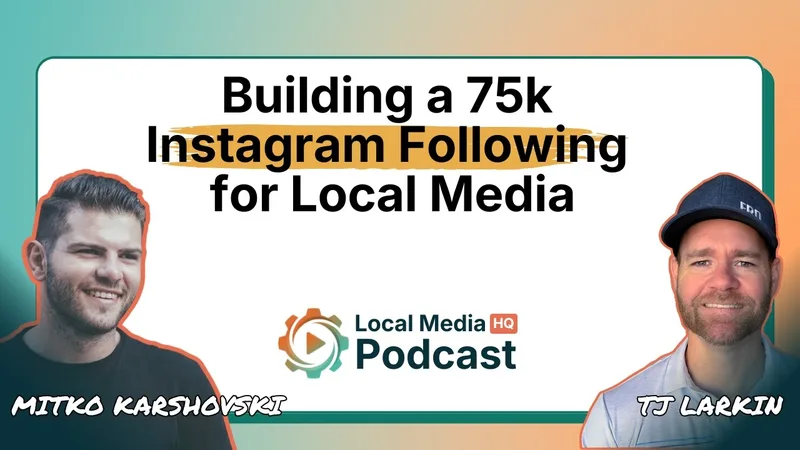
- Instagram brings the readers. Cincy Scoop has 75,000 Instagram followers and about 12,000 newsletter subscribers, and almost every reader comes in off Instagram.
- Quantity breeds quality. Make 100 posts before you worry about anything else, then sit down and ask why the hits worked and why the flops didn't.
- Skip the $100 ad slots. Local businesses still think in print terms, so Mitko sold packages of newsletter ads and reels to bigger brands like IKEA, Red Bull and Boston Beer.
- The audience is a launchpad. Cincy Battles, brand events and pop-ups come from a simple idea: solve attention and trust first, then build what the city needs.
Mitko and his wife Sarah started Cincy Scoop in spring 2023, and today it has 75,000 Instagram followers and about 12,000 newsletter subscribers. In this conversation he explains how they found their groove on Instagram, why he would rather not sell a $100 ad slot, and how a local media brand turns into what he calls a local venture studio.
From a remote work newsletter to Cincinnati
Mitko launched a media company about remote work in 2018. It was called Remote Insider, it had about 20,000 subscribers, and he rode the COVID wave up and then rode it back down as the money left the space.
He also worked at Hampton, a community for tech founders started by Sam Parr, who used to run The Hustle. Mitko was the content lead and ran two newsletters there. "I really got to learn from literally the best in the business," he says. After Hampton he became a digital community strategist and helped build 20 to 30 online communities for big creators.
Then he and Sarah, after seven years of full-time travel, got hungry for community and moved back to Cincinnati, where he grew up. Googling around to catch up on the city, they found nobody doing local media the way online creators do it. So they started a newsletter.
Sarah knows Instagram, Mitko knows newsletters
Cincy Scoop works because their skills overlap. Sarah used to work for an Instagram consultant company, helping really big creators with things like ManyChat, so she saw behind the scenes of successful accounts. Mitko knew how to write a newsletter people enjoy and get good open and click-through rates.
They started in spring 2023 and spent four or five months writing the newsletter before they were even in Cincinnati. Once they moved back, it took a couple of months of posting to find their groove, about four or five posts to get the language right for the city.
Then one post went locally viral. They went from zero to 50,000 Instagram followers in the first year, then to about 75,000 in the second. Mitko says growth has plateaued, because their audience is specific and there are only so many people who fit it.
A specific audience in a big city
The newsletter's subtitle is "good news in the Queen City." Most of the audience is 25 to 40, maybe 45 at the top end, and about 70% of the Instagram audience is women in that range. The newsletter split is a little more even.
Part of that is just who Mitko and Sarah are. Part of it is that they think of themselves as more than a media company. They want to build a community and products, and that is the group they know how to talk to. It also tends to be a high-earning reader.
TJ made the point that a market of 2.1 million is big enough to niche down, while a suburb probably is not. Mitko agreed it comes down to the business model. In a suburb he would look at subscriptions, because the math on sponsorships gets painful when you are selling ads at about $100 a pop.
Why local businesses don't buy newsletter ads
Coming from the online business world, Mitko assumed newsletter ads would be easy to sell. They weren't. Local businesses still understand print: a half-page ad, delivered to 10,000 households, at a price they recognize. An online-only newsletter is a harder sell.
"I would rather not make money and find a different way to make money than to sell $100 ad slots," he says. He also doesn't see that model scaling to anything meaningful, and he hates doing sales.
So they went after the bigger companies in town that have budgets, and sold bigger partnerships than three ads. Last year they said they had room for six partners and split it up. Every package included Instagram reels. The reels are the hook, because brands understand social media and many have social media managers. How you package it matters a lot. Moving forward, that might change, since they keep working on new kinds of partnerships.
Selling to IKEA, Red Bull and Boston Beer
TJ's takeaway was to go up market, and Mitko agreed. You can have a $50 client messaging you all the time and a $50,000 client who just says publish it. He had no interest in managing a hundred clients buying ad slots here and there.
The brands they worked with were not just local. They were national brands with local teams or a local push: IKEA, Boston Beer (which owns Samuel Adams and Sun Cruiser) and Red Bull. TJ pointed out why that makes sense. If IKEA has a store in Cincinnati, it wants to market that store to Cincinnati people.
Our goal is not to extract as much money from our audience as possible. It's more like how do we do cool and add to the community. And if we're giving a lot of value, there will be a return on investment.
Cincy Battles: a $25 pass for restaurants
The main product under the Cincy Scoop umbrella is Cincy Battles, a monthly battle pass. Each month is a different category. People pay $25, and in the wings example Mitko gave, about 12 restaurants take part and each gives four free wings. An app tracks usage.
Cincy Scoop also surveys the people who redeem. It asks whether they are first-time or frequent customers, what they thought and what their favorite item was. Because the data is tied to the restaurant's POS, each restaurant gets a clean dashboard showing how many new customers came in and how much money they made, even with the free product.
The idea came from a friend named Rob, who runs City Battles in Tampa and St. Pete. Cincy Scoop licensed it from him, and Cincinnati is the only city Rob does in collaboration. To get restaurants on board, Mitko says it comes down to communication and operations: SOPs, email templates and presenting themselves like a serious tech startup. That earns trust. They also only pick categories where enough good places exist and where a restaurant can afford to give something away.
Steal like an artist and make 100 posts
Asked what he'd tell someone who wants 75,000 followers, Mitko doesn't hesitate: "Steal like an artist and quantity breeds quality." He and Sarah constantly send each other reels and ask how they could spin an idea for Cincinnati.
In the beginning, you just make 100 posts and don't think about anything else until you get there. Everyone says quality over quantity, he says, but to get quality you have to go through a lot of quantity.
When something works, they step back and ask why. They've had multi-hour meetings going through their own posts and other Cincinnati creators' posts. When they post something they think will be a banger and it flops, they ask why too.
A few things they learned:
- Non-alcoholic guides worked early. People wanted NA-friendly things to do. It stopped working eventually.
- Cincinnati Pride crushes. He means hyping up Cincy, like sizzle reels of the city. It gets lots of reshares, though the conversion to followers is weaker.
- Specific guides work. A visitor's guide offered through ManyChat ("comment this to download it") works as a lead magnet. People reshare it and comment on it.
How often to post? Mitko doesn't think they've ever done more than two a week. When TJ asked about two to four a day, he called that obnoxious. He says to focus first on whether your hooks, editing and storytelling are good, and do as many as you can while still thinking about each one. In a town of 150,000 there's nothing happening that warrants five posts a day.
Venture studio: the audience as launchpad
Mitko calls Cincy Scoop a local venture studio. Because they have an audience, they can launch products, services and businesses under it and see if they have legs. He has a full-time job and Sarah only went full-time on Cincy Scoop a year ago, so they are careful. "You don't want to make the Jenga tower too high without having a strong base."
They know what the next thing is but can't say yet. He guessed it would launch around summer, hopefully. His filter is: what can we do that makes everything else easier or unnecessary?
He gave a small example. A friend and he have been spitballing a sauna and cold plunge on an unused plot of land in a neighborhood that doesn't have anything like it. He guessed it would cost about $15,000. The questions are whether the neighborhood, the nearby businesses and the development company that owns the land would be into it. "It doesn't need to be like, all right, this is a whole new business and we need to get an LLC. It's like, no, this would be rad. Let's just do it."
- 01You have attention and trust
That solves the "if a tree falls" problem
- 02You pick something exciting
Something cool you can point that attention at
- 03You prove demand
Show there is real interest in it
- 04You find the money
Sell sponsorships and partnerships, build a model that doesn't need them, or both
Events and brand experiences
The next thing is hoped for this summer, but in the meantime they are moving from a pure media company toward something broader. Mitko says they've had a lot of success selling events and experiences to brands. They also work with city development companies on events and activations around town and get sponsors for them.
"We're starting to come out of this bubble of essentially just being creators with a newsletter," he says, "really settling into or accepting the fact that we're actually a local organization."
TJ treats ads as a supplement, and Mitko calls them a commodity and a pain. His challenge is to think about what a $20,000 package would look like. Companies want a local activation, he says, because people are tired of being online, and the content from an event can feed more advertising afterward.
Questions people ask
What is Cincy Scoop?
How did Mitko and Sarah grow to 75,000 followers?
Why doesn't Mitko sell ads to small local businesses?
What is Cincy Battles?
TJ is the founder of Local Media HQ. Every week he talks with local media operators about what is actually working in their towns.