
Why a Seattle parents newsletter sells ads so easily
Mike Richardson quit his job to start Kid Friendly Seattle. He has 4,600 subscribers, a LinkedIn AI agent booking his sales calls, and a plan to sell the brand in five years.
 TJ LarkinHost, Local Media HQ PodcastApril 17, 2026 · 9 min read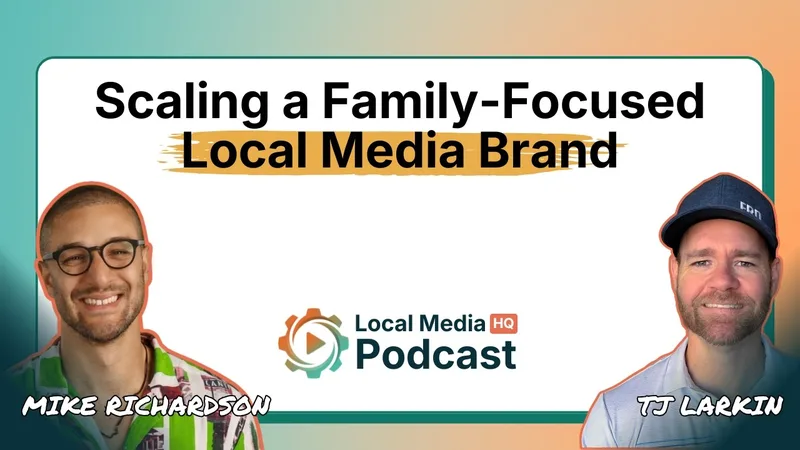
- A niche makes the sponsor pitch easy. Mike writes for Seattle parents, so camps, nanny services and kids' museums already want his exact audience. His biggest advertiser is a nanny service that books as many ads as he'll allow.
- Two hacked ad accounts forced a better strategy. After Meta disabled his account twice, he grew through weekend event lists, free-things-to-do lists and Instagram swaps with local businesses.
- An AI agent fills his calendar. For about $17 a month, Marblelism sends LinkedIn invites to businesses like his current sponsors. A $300 client came in the first month, and he is now booked out a couple of months.
- He is aiming at big sponsors and an exit. He wants about 20 big brands on yearly packages, a second location on the Eastside, and a sale of the whole business by year five.
Mike Richardson started Kid Friendly Seattle on July 1, 2025, after he quit a full-time job. About nine months later he had 4,600 subscribers and his sales calls were booked a couple of months out. In this conversation he explains why a family niche is easier to sell than a general city newsletter, how two hacked ad accounts changed his growth plan, and why he wants to sell the whole thing in five years.
From a self-driving newsletter to Seattle parents
Mike first wanted to start a newsletter about self-driving cars, called The Shift. Before he committed, he looked at who advertised in that space. Almost no one did, apart from maybe Waymo, so there was no revenue to chase.
He had always liked local, but Seattle already had a few local newsletters. So he asked who would pay to reach Seattle kids and parents. The list was long: pediatric offices, museums, fairs, weekend markets, camps. He also had a three-year-old at home. "How do I get paid to be a dad?"
Two hacked accounts and a growth plan without ads
Mike began paying for Meta ads right away and was getting good at tuning them. Then his ad account got hacked and Meta disabled it. His growth fell to almost nothing. He found a workaround, and it was hacked again. Someone had been in his email the whole time.
That pushed him to grow without ads. He had already started doing what he calls BOPA, borrowing other people's audiences. He promotes a weekend market or a kids fair, shares their content, and they reshare his. Instagram is where he picks up subscribers, and LinkedIn is where he finds sponsors.
The newsletter changed too. It began as four things to do with your family that week or month: something free, something paid, an upcoming event and a few kid-friendly places to eat. Then he saw a Seattle events company posting all the free things happening each day, and he started doing the same for kids. Weekend event lists became another regular section.
A second market across the lake
Seattle has a second audience on the Eastside, which includes Bellevue and Kirkland. Mike looked up the family counts and found about 600,000 families in one area and 500,000 in the other. He just launched Kid Friendly Eastside and sent over the subscribers who already lived there.
He hopes to sell that edition by throwing it in with Seattle packages. If a Seattle sponsor wants it, he will add an Eastside placement for very little or for free, so the new list builds a sponsor base. TJ's view in the conversation was that two nearby brands are worth more than double one, because regional advertisers want more area covered.
Why sponsors say yes faster
My audience is Seattle parents, Seattle families. And who almost doesn't want to market to those guys? Unless it's a nightclub or things that are just for singles or something like that. It's a pretty specific and very valuable market to own.
His first sponsors were not a cold pitch. He would feature a local business's event, then go back with the numbers: how many people saw it and how many clicked. Then he'd suggest a partnership and a package. Camps came first, since spring and summer are busy for them. His biggest customer now is a nanny service that is constantly selling out and buys as many ads as he will sell her. He limits how far ahead she can buy, because his audience keeps growing and he can charge more later.
Mike also treats trust as part of the sale. If a business tags him in a post or makes him a collaborator, he shares it with his audience for free. They remember that he isn't only there to take their money, and they come back every time they have a new event.
An AI agent that books the calls
Mike did not like the back and forth of selling. He bought a plan with an AI platform called Marblelism. It cost about $17 at first, and it landed a $300 client within the first month.
- 01Connect it
The agent runs on his LinkedIn, plus a separate Gmail account he made for it.
- 02Describe the target
He tells it the kinds of companies he already works with and asks it to find similar ones.
- 03Send the invite
It sends a LinkedIn invite with a short note saying he runs Kid Friendly Seattle and would like to get their company in front of Seattle families.
- 04Book the call
Its only job is to get a call booked, so every note carries his Calendly link.
Cold email through the same tool did not do well. LinkedIn has been "really, really good." He is now booked out about a couple of months, and his only work is the calls.
What his ads cost
Mike sells three things. The main ad sits at the top of the newsletter, which goes out Tuesdays or Thursdays. A weekend classified puts a camp's or museum's event at the top of the weekend list, with an image. Social posts and reels are the third.
- Top-of-newsletter ad: $150, or $400 for three.
- Weekend event listing: $50, or $125 for three.
- Reel: $100 flat.
For a reel he drives over, films for five to ten minutes, and lets CapCut's AI edit it with music. The business approves it and adds him as a collaborator. He has not settled the price yet. He is thinking about charging more for a visit, and about whether to skip the visit if a business films its own footage.
Punch cards that sold slowly
Mike got the punch card idea from this show's episode with Tad, and he talked to Tad afterward. The card costs $20 and gives 20% off one time at each partner. He picked kid-friendly places he had been to or that readers recommended, including a donut shop, a kids' consignment store, a play cafe, a museum, a plant nursery and a cat cafe. He had an April 1 deadline.
His twist was making media kits in Canva for each business, with a card design that matched its look, so they would want to share it. The math was tempting. The partners had about 300,000 Instagram followers combined, and 1% buying at $20 would be $60,000 a year. So far it has gone slower than he hoped, with about 10 sales. It still works as one more offer in the sign-up flow, and he tried it himself: three stops with his daughter saved $20.
A dad event first, then KidFest
Mike's first event idea is a box car race at a brewery, aimed at dads. He knows brewery owners from his waffle days, and dads who build cars with their kids get a reason to talk to each other. His audience skews toward moms, and he sees fewer groups for dads. TJ pointed out that people avoid plain networking events, but an activity takes the pressure off.
Rosie, a company that provides on-location babysitting for events, is already one of his advertisers. He has offered to promote one of their events for free.
The bigger plan is KidFest, which he hopes to hold toward the fall. Instead of fixed booths, vendors would roam. An Arena Sports rep might walk around with a goal and a ball and invite kids to score. Smaller vendors would hand out product in place of a booth fee, so a ticket gets people a pile of free items.
Where he is going
Mike's goals for the year are 10,000 subscribers and $10,000 a month in revenue. He also wants $10,000 in product or service sales, sponsorships booked 80% for the full year, and one small event and one big one. After talking with another guest, he plans to focus on about 20 big sponsors with packages around $10,000 and leave room for smaller ones.
Large brands may not need a tracked sale. A children's hospital such as Seattle Children's can pay to get its name in front of local parents. Mike also met a senior Disney Kids executive at a networking event who reads the newsletter regularly.
He sees ParentMap as his biggest competitor, a Seattle publication with about 20,000 subscribers after about 20 years. His plan is to grow the Eastside, add one more Pacific Northwest location, and sell it all by year five. That is why he removes his face and name from everything. He wants the brand to be an asset someone else can buy.
Questions people ask
Why is a family niche easier to sell to sponsors?
How did Mike grow after his Meta ads account was disabled?
What does Mike charge for ads?
What is Mike's long-term plan for Kid Friendly Seattle?
TJ is the founder of Local Media HQ. Every week he talks with local media operators about what is actually working in their towns.