
How Catskill Crew Makes Money Beyond Ads
Michael Kauffman runs Catskill Crew, a newsletter with about 40,000 subscribers. He explains his wax-sealed mailer, board games, real estate plays and how he sells sponsors.
 TJ LarkinHost, Local Media HQ PodcastNovember 3, 2025 · 10 min read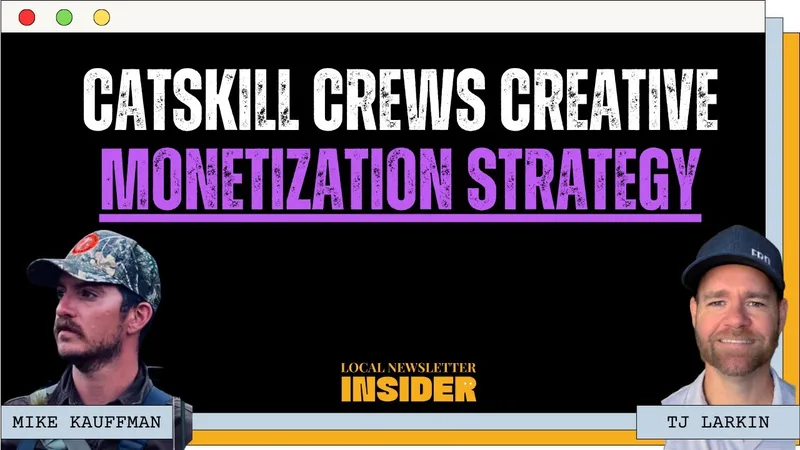
- A club of serious operators beats building alone. The Newsletter Club has 185 to 190 members in Discord, and the paid entry keeps out anyone who isn't committed.
- People will pay for something they can hold. His quarterly wax-sealed "mini almanac" costs $25 a quarter or $90 a year, and 98% of the votes in his audience poll said yes.
- Creative revenue beat his ad sales. Discount cards, events and the Catskillopoly board game outperformed traditional ads, and wholesale now moves hundreds of cases a year.
- Prove it before you sell it. Give warm contacts a free ad, then offer four weeks at half price, aimed at the sponsor's own goal, like a 2% click rate.
Michael Kauffman runs Catskill Crew, a newsletter for the Catskills region of New York, and The Newsletter Club, a paid Discord for people who run newsletters. He had never sent a newsletter before Catskill Crew. This was his second round with us, and we spent it on money: a paper mailer he is about to launch, board games, real estate and how he sells sponsorships. He also joined us back in March, and that episode is here.
Why he built a club instead of building alone
Michael says he was just sick of building alone. He wanted to build with other people who had different skills, so he pulled serious operators together to compound what they all knew.
The club is a little over a year old and has 185 to 190 members. Discord is the foundation because it has the highest response rate, so a question gets an answer fast instead of a week later. There are master classes and weekly calls, and a lot happens outside the channels. Members build software together in DMs and start new ventures together.
It costs money to join, and that is on purpose. "I don't want to hang out with people who aren't serious. It'll dilute the value for every single member."
Why he is mailing a paper almanac
Michael's take on print is simple. People want something physical, and they are digitally burned out. He thinks newspapers faded because the quality dropped once they started filling pages with ads. A half page story gets dragged out to three pages so there is room to sell more.
He did not try to guess what the whole world wants. He asked what he would pay for himself, and the answer was a piece of mail that shows up once a quarter. Inside a wax-sealed envelope is a mini almanac for the season:
- A couple of articles
- A note to subscribers
- Three stickers you only get as a premium subscriber
- An invite with two free drink tickets, each good for 24 hours at a local business
- A tree planted for every letter sent
It costs $25 a season, or $90 a year. Seven businesses have already said they want in on the drink tickets. He wants it to feel like a letter, not a printed newsletter: close your screens, pour a cold beer, sit by the fire.
He polled his audience in late August before spending a dollar. The vote came back 98% in favor, around 1,500 votes by his count. Most of the 3% who said no were worried about trees, so he promised to plant one per letter. He planned to announce it the first week of November, with the store set up in Shopify.
Discount cards, board games and wholesale
Michael started Catskill Crew thinking advertisers would carry it. Then he hit a wall. Businesses balked at spending even $250, and he wondered how he would reach six figures in year one. That is when he moved into what he calls creative monetization.
First came discount cards. He did them for growth more than money: ten local businesses promoting Catskill Crew, and it still made a few thousand dollars right away. Events added a couple thousand more. Soon those creative streams were outperforming his ad sales.
Then came Catskillopoly. He validated the board game with a poll in the newsletter, launched it about a year ago, and sold out in about two weeks. Now he sells wholesale, moving hundreds of cases a year to businesses. They double their money, and most of those shops have turned into advertisers or some other kind of partner.
The game also works as an ad. Someone pays about $50 for it in a store, flips it over, and finds out about Catskill Crew.
Puzzles did well too. There is a new Catskill Mountain Memories game coming, plus tote bags and crew shirts, and the hats sold out in about six hours. The wholesale demand surprised him: that day he was dropping off six master cases at $400 each.
- 01Poll first
Ask the audience and describe the thing in concrete terms
- 02Start small
He suggests 500 games on the first order, not 1,000
- 03Sell to shops
Wholesale buyers often become advertisers
- 04Let the product advertise
The back of the box tells buyers about the newsletter
Real estate as an advertising play
Michael thinks of Catskill Crew as a platform and a Trojan horse for many streams of revenue. He does not want ten copies of it in ten towns. He would rather go deeper in one place.
Here is how real estate fits. He and some partners bought commercial property and want to rebuild a town. If a restaurant moves into that space, he collects rent, and Catskill Crew becomes its advertising partner. He is the landlord, so he can say "you should check out Catskill Crew."
He is also looking at investing in local entrepreneurs. One of them makes ice cream, which could mean a Catskill Crew flavor. On November 4th he was meeting a hotelier about a possible hotel. None of these would carry the Catskill Crew name. But if he owns any piece of a hotel, even 0.01%, that is the hotel he promotes.
Not everything has to be called your newsletter, he says. He would actually advise against it, because the point is to spread eggs across more baskets.
Position yourself as the sun. Support as many businesses as you can, and that light's going to radiate back at you.
How he sells sponsorships
Michael says there is an education job first. Local businesses need to hear why a newsletter ad is different from other ads. He tells a story about a hotel GM who had just run an ad. Michael pulled up the numbers: something like 22,000 opens and 250 clicks, for a $250 ad bought as part of an old package.
The GM looked disappointed. He had hired an Instagram influencer who got about 50,000 views, but only two clicks out, for $1,500. Once he saw the math, he became a major spender in the newsletter.
His steps for a new publisher:
- Start warm. Pick five or ten businesses you already know, grab their logo off their website, and run a free ad. It costs them nothing, and they see their brand in the issue.
- Use the results. Then pitch a package. His example: if it usually runs $100 to $500 a week, offer four weeks at 50% off.
- Ask what success looks like. One wants a 2% click rate, another wants hotel bookings, another wants 500 people at an event. He builds the ads around that goal.
- Skip the one-offs. One-time ads rarely perform, so he asks for four weeks in a row.
Most of his ads come through the newsletter itself. Under each ad he puts a call to action for business owners to reach out. He also says never miss a send, because print and radio never do.
Cold outreach and the media kit with no prices
He is also running Apollo to cold email national brands. His first call from it came the day before we recorded. The advertiser said success meant a 2% click rate and gave him a budget. He did not push back, even though it was low, because the goal was to hit the number and earn the next order.
He paid a friend who is a consultant for a couple of hours to set Apollo up, which saved him months of bumping into rocks. LinkedIn outreach goes alongside it. He says proven templates do worse than a plain note: "I freaking love your brand," here is my reach, here is my calendar.
His media kit has no prices. It exists to look bigger and more legitimate, and to show the ways they could work together. Pricing comes on a call, once he knows the goal. If a buyer demands a number, he gives a starting price and offers to cut it in half for a custom package.
He also says no to some money. He turns down large-scale property developers, because his readers want wilderness and don't like developers.
Events that pay on day one
Michael's events are low-production on purpose: foraging walks, concert nights, barbecues and dinner parties. They are raw and authentic, not built to bring in influencers.
His first event taught him how to de-risk it. He asked a business for $1,000 and they said no. So he offered to promote the business for three weeks, sell the tickets himself and keep that money. It sold out. He made around $1,300 to $1,500 on tickets, and the business did about $7,000 in bar sales and moved 12 hotel rooms on a Tuesday.
He now says get paid on day one, even if it is a $5 ticket. He avoids revenue shares because they get complicated, and prefers a flat fee. Then poll first. Going from zero to one is the hardest part, and a poll means you are delivering what people said they wanted.
His advice to other operators
- Know your goal. A local holdco takes different tactics than scaling AI-written newsletters across the country. Decide your true north first.
- Play the long game. Commit to every send. Michael is still at once a week because he wants every touch to be valuable.
- Go deeper, not wider. He builds products, events and partnerships in one region instead of cloning the newsletter.
- Limit the downside. Poll, start small, and offer a discounted four-week package instead of a one-off.
Questions people ask
Who is Michael Kauffman?
What is The Newsletter Club?
What is in Catskill Crew's mini almanac?
How does Michael sell newsletter sponsorships?
TJ is the founder of Local Media HQ. Every week he talks with local media operators about what is actually working in their towns.