
What Alex Hormozi Told a Local Newsletter Operator
Jas Singh paid for a call with Alex Hormozi, shut down his side business the next day, and is now building a 30-day break-even offer and a 25-day giveaway to grow Winnipeg Digest.
 TJ LarkinHost, Local Media HQ PodcastNovember 19, 2025 · 10 min read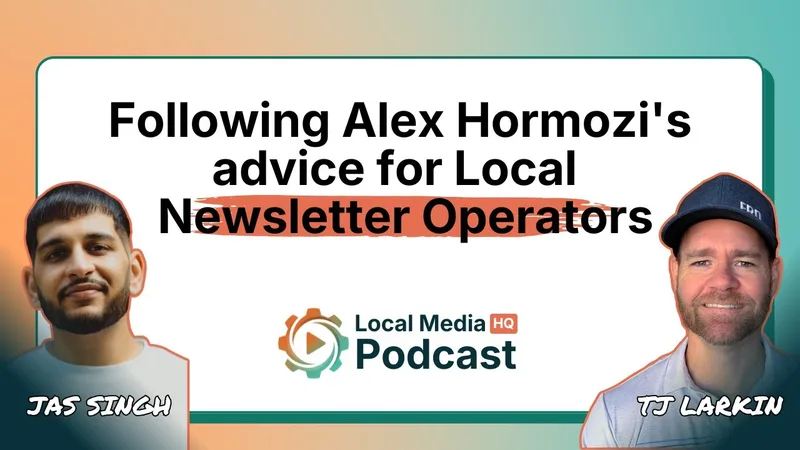
- Hormozi said his market was bigger than he thought. Winnipeg has a million people, and Jas had been happy with 40,000 subscribers when he could aim for 250,000.
- He shut down the Christmas lights business the next day. A $6,000 loss, but the time goes back into Winnipeg Digest, which already brings in about $12,000 a month.
- The real bottleneck is fronting cash. A subscriber costs about a dollar and pays back 30 to 40 cents a month, so he is testing a self-liquidating offer that breaks even in 30 days.
- A 25-day giveaway sells advertisers too. About $18,000 in prizes from local businesses, and two extra annual advertisers signed on because of it.
In this one Jas Singh tells us what happened when he paid for a spot on Alex Hormozi's hotline and asked how to grow Winnipeg Digest. We also cover the offer he is testing to make new subscribers pay for themselves, his plan to give away prizes every day in December, and how he talks to advertisers.
One note up front: at the start of the episode TJ says the show is rebranding from Local Newsletter Insider to Local Media HQ, because we are building local media brands, not only newsletters.
"Winnipeg has a million people"
Jas had bought Hormozi's $6,000 offer. One perk was a chance to get on his show and ask questions. Jas asked whether he should expand to other cities or niche down, and he mentioned the Christmas lights business he was trying to get going. Hormozi's answer was blunt: Winnipeg has a million people, so why be happy about 40,000?
His argument was that Jas could build a seven-figure business, maybe a million dollars a year, just selling ads in Winnipeg. Jas said he had assumed his market was much smaller than it really was. Hormozi also told him what he tells everyone: do more. He did say 120,000 people and 41,000 email subscribers in about 18 months was good growth.
Why he shut down Christmas lights
Jas said Winnipeg Digest was doing about $12,000 a month. Hormozi's point was that it is easier to take a $140,000 a year business to $250,000 than to start a new one from zero. Jas agreed he would probably cap out near the same range in any other business, because his skills are worth about that much right now.
TJ pointed out that the Christmas lights idea was good, since 300 people or so had filled out the interest form. Jas agreed. But the next day he shut it down and took a $6,000 loss, because that time was better spent on the newsletter over the holidays.
The math that slows growth
Jas's numbers are simple. He gets about 3,000 new subscribers a month, usually for around a dollar each, and each one is worth 30 to 40 cents a month. That is about three months to break even, and he is fronting that cash for Facebook ads.
Hormozi's fix is a self-liquidating offer, or SLO: an offer, or a sequence of offers with upsells and downsells, that earns the dollar back in the first 30 days. If it works and a subscriber costs under $1, Jas says he could put $10,000 into ads and add 10,000 subscribers. TJ added that a B2B newsletter he knows turns a profit on each subscriber within seven days, though a B2B audience buys software and a local one mostly does not.
Five restaurant guides in the welcome sequence
Jas's first try is restaurant guides. There are five: best bakeries, best cafes, an Asian eats trail, European restaurants and North American dining. Two free bonuses come with them, and they arrive as seven PDFs through Shopify. He had launched only to the welcome sequence, made his first sale at about $24 two days earlier, and is testing landing pages and a $9 price. At $9, he figures he needs roughly a 14% conversion to break even.
A friend suggested pairing the guides with 20 restaurants offering $10 off each, so the $23.99 price comes with about $200 of value. TJ liked that idea. His point was that the guides alone are not a no-brainer offer, but the gift cards could make one.
The second I can solve this problem, I can scale to other cities without thinking twice about it. I can put as much money as I want into Facebook ads and break even.
Jas puts the problem's value at the $36,000 a year he spends on Facebook ads, plus every city he might add. Until it is solved, he is not working on anything else. TJ said he has 15 newsletters and hopes to have about 30 soon, so a fix would pay off many times over for him.
25 days of giveaways
The idea comes from YouTubers doing Vlogmas, where a daily schedule gives them an excuse to post every day. Jas posts once a day on social now, and the giveaway lets him post twice a day without it feeling strange. From December 1st to 25th he is giving away something every day from a local business, worth $15,000 to $18,000 in total. Prizes include spa, restaurant and cafe gift cards, a Jets ticket and a $3,000 diamond ring from a local jeweler.
For the lead capture, a ManyChat automation DMs every new follower and asks them to subscribe by email. He sees about a 10% conversion, so 10,000 new followers would mean about 1,000 new subscribers. His goal is to go from 67,000 social followers to 80,000 by the end of the year.
How he filled 25 slots:
- Current advertisers. Only three or four of the 25 came from existing advertisers.
- Businesses that wanted in. Many had wanted to advertise but could not afford it, so he offered the giveaway slot, worth about $3,000, as a holiday gift.
- A bigger-than-10,000 rule. He only asked businesses with over 10,000 followers, since each one does a collab post with him.
- Annual advertisers. He pitched a $15,000 annual partnership (an Instagram slot is worth $2,500 on its own) with the giveaway thrown in if they signed before the end of November. Two more annual advertisers signed that way.
A team of two
Jas used to have four people, including part-time VAs, and says he was paying people who were not doing much. Now it is him and one full-time VA, who writes the newsletter and builds the guides from his designs. He sends the newsletter three times a week. It used to take him four hours an edition, and now it takes about an hour to an hour and a half, about four hours a week instead of 12.
He also stopped doing outreach. Since the audience is growing, inbound requests now come to him, and he says his main goal is to grow the audience so sales follow.
What Beehiiv's new tools do and don't do
TJ had not watched Beehiiv's announcement yet. Jas had tried the new products feature that morning. It allows one image and one PDF per product, and he needs several images and seven PDFs, so it is no use to him yet. He likes the podcast integration, and does not like link-in-bio pages with a menu of choices. A local newsletter, he says, should control the path and push people to subscribe.
TJ called dynamic content the feature he was most curious about: show different sections of the same email to different people based on their tags, like a different restaurant of the week for south Winnipeg and north Winnipeg. Jas agreed it was the best thing in the release, though he was not big enough to test it yet.
The split-ad idea came from Hormozi. At 250,000 subscribers and a 50% open rate, Jas figured 125,000 opens and about $12,500 an ad at a $100 CPM, which few local businesses can pay. Hormozi's answer was to split the audience randomly in two and sell the same edition to two advertisers at about $5,000 each. Jas said that at that size he would not need survey tags to do it.
How he gets in front of advertisers
Jas spent $20,000 before he made his first $1,000, expecting that one annual advertiser at $20,000 would break even. That is how it played out. When he went to advertisers, he had 15,000 to 16,000 subscribers and 30,000 Instagram followers after six or seven months. His pitch is that this is the fastest-growing media brand in the city, their price locks in a year of growth, and their competitors cannot get it.
- 01Get to about 15,000 subscribers
Until then, he says, not many people will pay attention, unless you are in a very small county.
- 02Grow a social audience and DM them
This is how he gets on a call. In-person events have not worked for him.
- 03Or grow until they come to you
Once you are the biggest brand in town, inbound follows.
- 04Use the giveaway as a bonus
Advertisers who sign before the end of November get a slot in it.
His proof that being biggest works: the city of Winnipeg's director of communications reached out and added him to media releases, and a visiting event producer told him seven people had said to advertise with Winnipeg Digest. His advice is to be bigger than everybody else locally, and to have a $20,000 budget if you want to do it fast.
Pitch it like a machine
TJ asked about small advertisers with $300 budgets. Jas says to talk about customer value. A friend of his runs a $5 million a year HVAC company where a customer is worth about $10,000, yet he was debating $60 versus $90 off a cleaning. Jas told him, you put in $600 and you get out $10,000, so use that machine. His pitch to advertisers is that the newsletter is that machine for them.
For a smaller advertiser, he suggests a three-month trial with a benchmark that turns into a one-year contract if it hits. With a realtor, he asks what three new clients are worth, then offers to refund $2,000 if he can't deliver them. TJ closed by asking what Hormozi would say, and the answer was: do more. Jas says that is his tagline for the next year.
Questions people ask
What did Alex Hormozi tell Jas Singh?
What is a self-liquidating offer?
How much did Jas spend before he made money?
How did Jas get businesses to join his giveaway?
TJ is the founder of Local Media HQ. Every week he talks with local media operators about what is actually working in their towns.