
A 300-listen podcast that feeds a 40,000-follower Instagram
Jacob Espinoza of What's Happening Salem on turning small podcast numbers into big clips, green screen reels, sponsor packages and a new social media agency.
 TJ LarkinHost, Local Media HQ PodcastSeptember 12, 2025 · 10 min read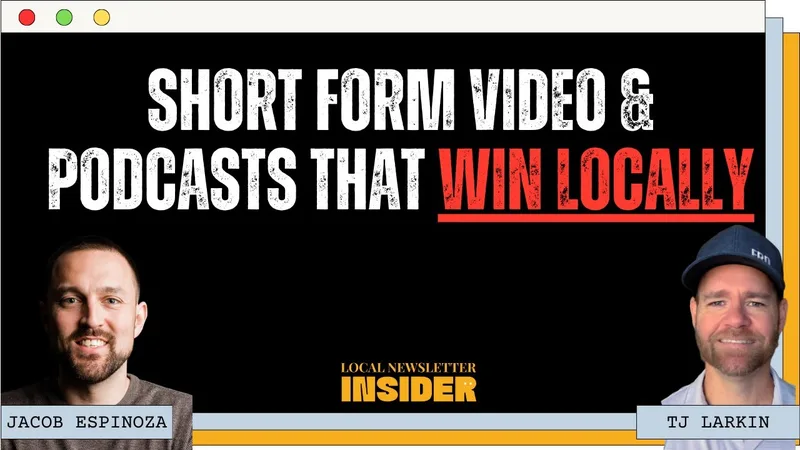
- The podcast is for access, not listeners. Jacob's show gets maybe 300 listens, but it gets him in the room with local leaders, and a clip from one interview can pull 10,000 to 20,000 views on Instagram.
- One interview feeds everything. A single conversation becomes a full Sunday newsletter send, Instagram clips and steady content for the page.
- Fast beats fancy. His green screen reels let one person cover a local story, like two people running for mayor, without going anywhere.
- Sponsored reels sell on social proof. A monthly reel plus newsletter spot is the easiest package he sells, and he fixes a flop with a make-good.
Jacob Espinoza runs What's Happening Salem, a local media brand with an Instagram page, a newsletter and a podcast. He has been on our show before, and this time we got into the details of video: how he uses a small podcast to feed a big Instagram page, how he makes reels fast, and how he sells sponsorships on top of it.
A podcast with 300 listens can still pay off
Jacob is blunt about it: it is extremely hard to grow a local podcast. Only so many people in a town listen to podcasts, and only a slice of them want local updates. He puts his own numbers at maybe 300 listens an episode.
He still does it, for two reasons. The first is access. When you are the person consistently telling your community's stories on Instagram, it is much easier to get the fire chief, the police chief or the city manager to sit down with you. Some of the people listening, he says, are in influential seats.
The second is content. The podcast gives the Instagram page a steady supply of material. The podcast gets 300 listens, but a clip from it can get 10,000 or 20,000 views.
Money from the podcast itself has been tricky. He had a sponsor for about a year, but it was hard for them to square the listen count with what they were paying. Now he sells per episode when the topic fits, like a food industry episode for a restaurant sponsor. He has only done that twice in a year, and he thinks a title sponsor would be easier.
I think the important piece to make a podcast sustainable is to make the production as easy as possible.
Record it on Riverside and move on
Jacob and I both use Riverside. He tried recording in person for about two months. In-person is better, he says, but it was not worth how hard it made it to keep going, so he went back to remote.
He also mentioned a brand new Riverside feature that publishes the show to the podcast platforms, YouTube included. It had just launched the week before we recorded, and he said it only works if you start a new podcast, not on an existing feed.
One interview becomes a newsletter send
Jacob sends three newsletters a week now. Sunday is his, and it is often built from the podcast. He did one on what it is like to be a restaurant owner in Salem, including the taxes being proposed. He had AI rewrite the episode as an article, then went back to check the facts and edit it.
When he started, there was one send a week and the podcast was a short summary with the sponsor's name on it. Now whole issues come out of one interview.
He sends in the evening, which he admits he picked to stand out, since so many newsletters land in the morning. His view is that his is the one you read after work. He has not tested it much, but his open rate is about 55% on average, and he credits a scrub of inactive subscribers for part of that.
For subject lines, he screenshotted his Beehiiv list of subjects and open rates and asked an AI chatbot which ones did best. That became a prompt he now uses to write subject lines. It still does not always come out great, he says.
Clips that work are not teasers
Jacob's clips do well, but they take an editor who understands Instagram. Plenty of podcast clips flop because they are made as a hype reel: a teaser for the episode instead of something worth watching. What works is value or a hot local topic that gets people commenting.
Length matters too. He says even a minute is too long right now, and he aims for 25 to 30 seconds, sometimes 40. He wants viewers to feel like they want a little more, and he puts extra detail in the caption.
For a year he had an editor named Dylan, who was paid out of the podcast sponsorship and was the best Jacob has seen at finding the moment that will work. His new editor needs more guidance. His take: if you pay less, expect to do more of the thinking yourself.
I brought up the cheaper overseas editors I have tried. The cuts were technically fine but the clip would end at second 35 when the point came at 40. Jacob said it is not an overseas problem, it is a talent problem.
If you are just starting, his advice is simple: post the imperfect clips. Four so-so clips teach you more than sitting in a room never posting.
Getting your first guests
Jacob says he can mostly book anyone now, unless the person is wary of media in general. Early on he was probably too nice and did not ask hard questions, which made it easier to get guests. Listeners called him on it, and he now asks tougher ones.
His advice to a new host is to start with who you know. It does not have to be a perfect guest or perfect timing, and guests get easier once they can see what the show looks like.
I added a couple of tricks. If you have a newsletter, announce the podcast at the top and ask for guests or recommendations. You can also put a booking link at the bottom. Once in a while you get an imperfect guest, but it still works out, and it is an hour spent expanding your network.
The green screen reels
Jacob does not call his style new. He says he took what was working in other industries and applied it to local. Trends burn out fast, he says, so his focus is on the goal: tell the community's stories as quickly as possible with what he has.
The example he gave was the mayor's race. Two people are running for mayor in Salem, and he does not have a team around him. The Instagram side is mostly just him, with a couple of people helping on the newsletters. So he asks how to tell the story in the shortest time while still giving the most value.
I told him that when I first thought about this, my instinct was to go to the building and film it. His point was the same one: make it easy enough that you will actually do it, because a reel that takes hours is a reel you stop making. He averages about two reels a day, some days four.
How he sells sponsored reels
The package is one reel and one newsletter spot a month. Jacob says it has been going well, and they just raised prices. It is also the easiest thing he sells. Buyers can see the followers and the engagement, and they can see that their own friends follow the page.
His business collective is a group of businesses that support the page every month and get one reel each. He spaces them out as much as he can, and one-off paid reels come in too. His goal is for an ad to feel like another piece of content. If he has sponsored posts three days in a row, he posts at least three times on those days, and sponsored posts are a small share of what he publishes.
He makes the content himself. For a rodeo sponsor who wanted it to feel like a family event, he talked to a mom on the phone, took notes on how she described it, then cut clips and photos she sent from the year before into a reel. It was around 15,000 views, though he said he wanted to double check that.
If a reel flops, he does a make-good. That can be another piece of content, or smaller things like tagging the business in his stories or using Instagram's reshare button on their posts. He cannot promise a business will sell more product, but he can make sure the attention was real and the call to action was clear.
His pitch to businesses is not about clicks. He cannot compete with Facebook and Google on cost per click, he says, and the businesses that buy get that. They want to support something good for their community.
Instagram is, in his words, the cheat code for sales. Businesses still buying billboards struggle to picture an email ad, but they have been told for years to be on social. Adding the newsletter lets him offer more instead of lowering his price.
It is also stressful. His title sponsor paused one week, and that Friday a smaller sponsor wrote to say they were getting tons of leads and wanted more visibility. He still worries about what happens if everyone stops advertising tomorrow, or if Instagram shadowbans him.
Cash drops, list reels and a weak website
On the topic of cash drops, Jacob has done two with his own money and gained a significant number of followers. A couple of businesses then offered him $50 to do one at their location. I said that when we posted ours, someone found it within 15 minutes, even though we hid it on purpose.
For pages that are not video-heavy, he suggested paying someone on Upwork around $20 to turn a weekly to-do list into a reel with text on the screen. He pointed to another Oregon page with about 21,000 followers that is mostly to-do lists and memes.
He also paid someone to build a website with a job board and an event calendar. Nobody visited it, so it was an expense with no return, and he now sticks with what works.
A social media agency for creators
His newest project is an agency. The gap he sees is that some creators know how to make engaging content, and some businesses want to invest in social but do not know where to start. He pairs them up and acts more like a coach on strategy.
He is working with a couple of locals who have grown their own channels, and right now it is only in Oregon. He says they charge less than what many businesses were paying someone to do it in-house, and the results are better. He does not expect to work with restaurants, since margins are too thin for that kind of investment.
I told him most local businesses need help with everything except the business itself, and he agreed. He also runs a coaching service for people who want to grow local Instagram channels. While we were recording, someone he started working with two weeks earlier, with about 250 followers, got a title sponsor interested.
Questions people ask
Why is a local podcast hard to grow?
How does Jacob use one podcast interview?
How long should a podcast clip be?
How does Jacob sell sponsored reels?
TJ is the founder of Local Media HQ. Every week he talks with local media operators about what is actually working in their towns.