
Why a Media Brand Is Worth Real Money
Dylan Redekop of Growth Currency on the Barnacle Strategy, building a brand someone could buy, the fake double opt-in, and why Substack might be low-hanging fruit.
 TJ LarkinHost, Local Media HQ PodcastApril 20, 2026 · 9 min read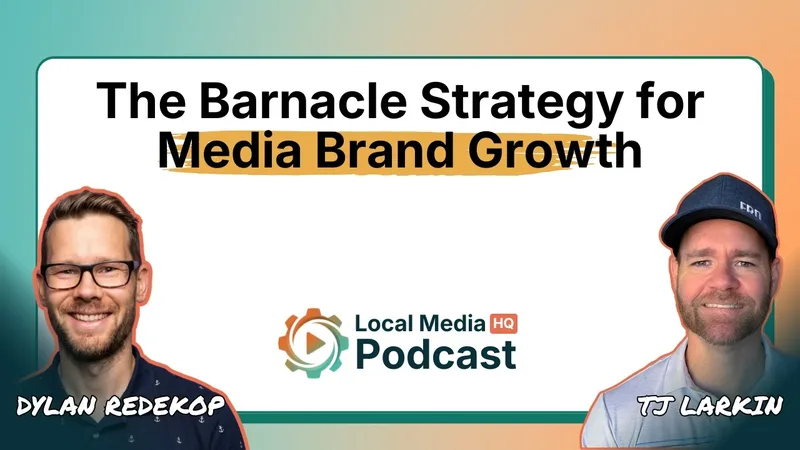
- Buyers want attention. TJ points to OpenAI paying $200 million for a media brand under two years old. Dylan says attention is the currency, and money alone doesn't buy it.
- The Barnacle Strategy. Build a newsletter around one big company's world, like Notion, and it can become the obvious thing for them to buy. Dylan says HubSpot paid roughly $10 million for Starter Story.
- Pair your name with a brand. Justin Welsh is the business, so it's hard to sell. A name plus a business name, shown side by side, is easier to hand off.
- Fake double opt-in. Keep single opt-in, send a confirm email anyway, remind once, then cut non-clickers so they stop counting against your plan.
Dylan Redekop doesn't cover local news. He writes about newsletters and media at a national level, and TJ brought him on because that outside view is useful. We talk about why big companies are buying audiences, how to build something an acquirer would want, why local has an edge, and the welcome email trick TJ recently put on his own list.
What Dylan saw at the New Media Summit
Dylan was the MC at the two-day New Media Summit in Austin, and the part he liked best was the live interviews, including one with Sam Parr. TJ added that Sam is now building something in person with local chapters, which is just another way of saying local.
He also met newsletter founders who had quietly grown huge. Connell, a sales person at Half Baked, told him they had just crossed 200,000 subscribers. Dylan says the newsletter is packed with business ideas five or six days a week.
Another one stuck with him: ADHD Weasel, run by two young guys who also went to UBC. After the summit they told Chenell that a quiz tactic she taught took them from about 17 signups a day to over 100. Dylan clarified they use some paid growth too, with a free quiz tool driving both.
What OpenAI's $200 million deal means
TJ raised the OpenAI deal: a media brand, mostly a podcast, less than a year and a half old, for $200 million. He read the name as TBPN. His point is that people in unrelated industries are suddenly talking about what an audience is worth, while almost nobody is saying it about local.
TJ's second-order take is that AI means more businesses fighting for attention, so ad costs go up and a loyal audience becomes worth more. Dylan's word for it was attention. If you have the funds you can buy subscribers, but that doesn't mean you have their attention. Keeping it takes deliberate focus on quality so people stay, don't churn, and share what you send.
The Barnacle Strategy
Dylan first heard the term from a guest on the Growth in Reverse podcast and isn't sure who coined it. The idea: create a newsletter that a larger company could buy.
His example is Notion. They're big and have money, but Dylan hasn't seen a strong media brand around them. You could build an all-encompassing productivity brand, or go narrow and be the unofficial Notion newsletter. Get the personalities and branding right, and one day you could pitch Notion or Notion could come knocking. He says the same logic applies to Figma, Canva and other software tools. He admits it's easier said than done.
His real case is Pat Walls and Starter Story. Pat built the audience over five or six years with content people loved, then HubSpot paid, in Dylan's words, "upwards of 10-ish million dollars."
Why local still works
TJ's argument is that national niches like entrepreneurship, AI and tech are brutal, and local has far less competition. You also don't have to win people over to love the place, because they already do. His caveat is that your total market is smaller, so it's more of a lifestyle business.
Dylan agreed the market is smaller but said the value per subscriber could be much higher, since people are more invested. A town of 10,000 gets tricky because everyone knows everyone. Above that, he pointed to Ryan from Naptown Scoop. Annapolis has only about 40,000 to 45,000 people, and Ryan has almost half of them on his email list. He has since used that list and the money it made to buy other businesses, including a luxury toilet rental for weddings.
TJ's follow-up was events. People are starved for real connection, and non-local media brands are chasing events for the same reason. His tip is to give each event a topic, like a history professor giving a 20-minute talk on the town, so there's a reason to show up beyond hanging out.
Dylan's idea is to look at the businesses already in your town and build an event around each: a mountain biking day with the bike shop, a run club night, a fashion event with local clothing stores. The shop can sponsor it. TJ would rather be the curator who puts a venue's space in front of his audience than host everything himself.
Pair your name with a business name
TJ asked whether a media brand should lean on personality. Dylan said yes, because people want to hear from people, not a logo. The catch is the exit.
The challenge, the rub on that might be the off-ramp, if you're hoping to exit this business. Like, can Justin Welsh sell his business? Probably not, right? He is the business. His mind is the business. His voice, his face, the name of the business. So that's harder.
Chenell at least branded her work Growth in Reverse, so a buyer would be getting something that isn't only her face. A brand that is purely "TJ Larkin" is harder to sell than "TJ Larkin" plus Local Media HQ. Dylan's rule is to show your name and the business name side by side, always.
TJ's local version: his own brand is Leander Scoops, with him and his wife as the faces. As it grows he plans to hire a creator, then a second, so the brand becomes more than them while staying creator-led. He named Plant Daddy as someone who did this on YouTube, adding more creators over time and making less himself. We hold that up as the way out of "I can't leave."
The fake double opt-in
Real double opt-in means subscribers must click a confirmation email, and if that email lands in spam, they never join your list. Dylan didn't invent the fake version. Chenell and a Growth in Reverse Pro member used it, and he has been promoting it and wrote a guide.
- 01Set your email provider to single opt-in
Anyone who subscribes is on your list right away.
- 02Send a confirm email anyway
It asks them to click if they really want in. Dylan tags clickers in Kit.
- 03Email non-clickers again
Unlike true double opt-in, you can still reach them.
- 04Send one reminder, then unsubscribe them
They stop counting toward your subscriber cap, which can cost money.
He said Germany requires double opt-in by law, though most places treat it as a recommendation. The reason he cares: he had a podcast guest couple on LinkedIn with over 100,000 followers each, and they had about 55,000 unconfirmed people against a confirmed list of around 45,000.
Dylan's own version is more of an opt-out. The welcome email tells people why they got it and offers a huge unsubscribe button if they didn't mean to join. He only does that for passive subscribers, like people who come from Substack recommendations. Visitors who come straight from his LinkedIn profile get a normal welcome email, since they clearly meant to sign up.
Substack as a growth channel
Dylan uses Substack for growth, not publishing. He posts notes and promotes his newsletter there, adds new Substack subscribers to Kit, and only sends through Kit, so nobody gets double emails.
TJ's question was whether a local newsletter should do the same. Dylan said yes: it's free, it's growing and it's becoming more like a social platform. If the content already exists, he'd try it. People can follow you first and subscribe later, so you attract fewer passive subscribers. TJ called out that copying posts over is a one-time setup. Dylan also suggested finding other writers in your area through keyword searches and swapping recommendations. Those cross-promos work on Kit and Beehiiv too.
What Dylan and Chenell are building
30 Days of Growth is a pop-up newsletter that runs for 30 days and then disappears. It's free, and each day brings one email list growth tip from someone who has tried it, who gets promoted in return. Chenell also records a short daily voice note of five to eight minutes. Sign up at 30daysofgrowth.co. It starts April 20.
Growth in Reverse Pro is application-only, with an annual commitment and about 80 operators, including a couple of local newsletters. It isn't for beginners. Dylan says you should already be running a newsletter and want to 10x it. Members get creator sessions, monthly ask sessions and hot seats.
Questions people ask
What is the Barnacle Strategy?
Is the fake double opt-in legal?
Should a personal brand have a business name too?
Is Substack worth it for a local newsletter?
TJ is the founder of Local Media HQ. Every week he talks with local media operators about what is actually working in their towns.