
Why Marin Buzz Is Selling Instagram Followers More Than Email
Brian Skinner is five months into Marin Buzz. He found advertisers care more about his Instagram number than his email list, and now he sends five DMs a day to the followers he already has.
 TJ LarkinHost, Local Media HQ PodcastJuly 18, 2025 · 10 min read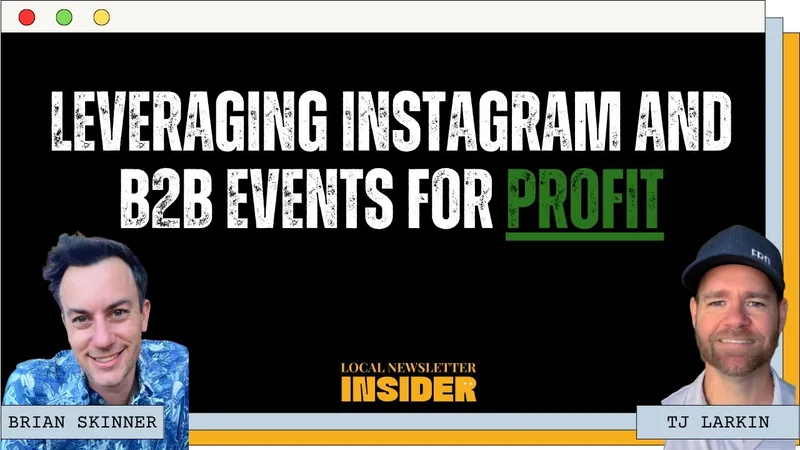
- Advertisers want the Instagram number. About two-thirds of Brian's email subscribers open each issue, but local businesses still ask about his Instagram count first. So he stopped arguing and started building it.
- He sells to people who already follow him. Brian DMs five of his own Instagram followers a day, with a short, personal message. He gets at least one reply a day, from businesses he would never have thought to pitch.
- His first ads were small and short. A local gym pays $250 a month. A preschool and a pop-up wine tasting each got a $100 one-month trial. He avoids long contracts while his audience is still growing.
- He built a tool to cut the video work. YapOver lets him talk over a video someone else already posted, with no editing software. It was his way around the friction of making content.
Brian Skinner started Marin Buzz in the middle of February 2025, a month after he heard one podcast guest talk about local newsletters. Five months later he has about 4,400 email subscribers and 3,300 Instagram followers, and he has learned something that changes how he sells ads. In this conversation he explains why local businesses care more about Instagram, how he grows it without wrecking his account, and the outreach routine that is getting him a reply a day.
One podcast episode was enough
Brian says he doesn't know when he first heard of local newsletters. The tipping point was the Nicconomics podcast, where Jas, who runs Winnipeg Digest, talked about his experience in January. It clicked for Brian right away.
He had spent years in small business trying to get attention for a niche. What struck him was how easy it is to get someone to join a local email list, because everyone is curious about what is happening in their own backyard. He also heard that customer acquisition cost could be around 50 cents a subscriber, and he figured a couple thousand dollars up front might pay for itself within a few months.
He didn't have a specific plan for the audience. He just saw that being known locally would make everything easier later, including side projects that aren't businesses at all, like starting boys volleyball teams for young kids in the county. His first issue went out in mid-February.
What the newsletter sends
Brian's advice for anyone who hasn't started is to not build it up too much in your head. The first email can be rough, and you should frame it as something sustainable. His version was events: the 10 best things happening this weekend, with his own spin and a little comedy.
It started as one email a week. Then he added a Pet of the Week, where readers submit a Google form, and a Monday email with Marin History, a 500-word piece on a historical event or an interesting business. He gave Birkenstock as an example, since the sandal company was once headquartered in the county. There is also a Zillow of the Week, picking a mansion or a houseboat. Readers asked him to keep the events email on Wednesday morning, so that stayed.
His first advertisers
The first ones were inbound, readers on the list who asked if he did advertising. His best so far is a local gym that has paid $250 a month for four months. Smaller businesses and events get a $100 offer for one month. A preschool looking for students took one, and so did a pop-up wine tasting.
He keeps these deals short on purpose. If he locked someone in for a year at today's size, he would be selling himself short once the list grows. A one or two month package lets him raise prices as the reach goes up.
Why the Instagram number sells
When Brian started talking to businesses, he realized they care about the Instagram number even more than the size of his email list. That is true even though two-thirds of his email subscribers open each issue, while a page with 5,000 followers might get a thousand views on a post.
He admits it is a little crazy, and he doesn't plan to teach advertisers social media math. Businesses want a big public number, and having one makes everything downstream easier. So he shifted his Meta ads toward Instagram Reels. Email subscribers got more expensive, from around 40 cents to 60 cents, but he picked up Instagram followers along the way.
Five months in, he paused the ads about a month ago. He didn't want to get stuck in a loop of growing so the ads feel more valuable later. He wanted to reach a point where the list felt like an asset he could deliver value with, and then put his effort into filling ad slots.
Following people, carefully
Brian's early trick was following people in his community. They get a notification that Marin Buzz followed them, and he unfollows later so his ratio doesn't look off. Do a hundred a day and it takes about five minutes. He wanted to reach a thousand followers, because that is when it starts to feel more meaningful.
Instagram does have limits. He has seen a popup telling him he's done too much, at around 150 or 200 actions. His view is that doing it by hand is probably fine, while a browser automation tool is where Instagram can spot a systematic pattern. He treats it as a casual thing, a coffee break and a few profiles. He adds it is a short-term strategy and he does little of it now at about 3,400 followers. These days he puts the time into content that builds trust.
YapOver: talk over a video someone else posted
Brian doesn't love editing video and didn't think he would keep doing it. He builds products, so he built a workflow. The tool is called YapOver. It makes what he calls talking head videos: you take a video someone else posted, record yourself talking about it for 10 seconds, and the tool removes your background and stitches the two together. His example was a July 4th parade recap.
For scenic content he added a theme page option that puts a frame around a video. He did one for a series of hikes and ocean shots, and the tool can produce 10 at a time that he schedules through Instagram, one a day.
- 01Bookmark as you scroll
Event flyers, restaurant clips and recap videos. He saves them instead of liking them on the spot.
- 02Record yourself talking
The tool removes your background and puts you over the original video.
- 03Drip it out
Schedule about a post a day through Instagram.
- 04Tag the original creator
They usually appreciate it and may pick up new followers.
One idea he hasn't tried yet is a separate Instagram account that you train to show you only events and flyers. Brian also says the grand vision isn't an agency that does this for you. It is a dead simple tool that tells you what to say about which video, then post it. My own take on the call was that most people know they should be doing this and aren't, because of the friction.
What I added from my side of the call
We spent a while on events. I told Brian about a free AI class I ran for my town. Around 95 people signed up and about 35 showed up. The chamber of commerce pointed me to a senior living home with a movie theater room, and the manager told me to call anytime I want to host another event. I also pointed out you don't have to sell tickets: a sponsor can pay $500 for a table and a short intro.
I also mentioned an apartment locator who became one of our advertisers. She had no website, so we built her one, and she paid $400 a month and only ran two ads. In under three weeks she told me she had made $4,500 from them, and I told Brian that selling Meta ad management next could be the easy extra business.
Five DMs a day to people who already follow him
When Brian turned off the Facebook ads, he wanted a way to sell that didn't depend on personal contacts. His warm list was his email list and his Instagram followers. Instagram is better for this because you can see everyone who follows you, and each profile says what they do.
On Instagram, you have the complete list of who follows you, and their profile has some information about what they do. If you do send an Instagram message to someone who follows you, it goes right to their inbox. That inbox is usually monitored by someone who's in marketing. They're in charge of the Instagram account. So it usually goes to someone who's kind of the decision maker for running ads.
He used AI to pull his follower list into one place, along with each profile, link and follower count, and to sort out which accounts were businesses and how likely they were to advertise. Then he set a bite-size rule: five personalized DMs a day, about two sentences each.
For the past week or two he has gotten at least one response a day. Interest has come from an auto broker who finds specific cars for people, an old folks home and an orthodontist. He talked with an interior designer, and some owners asked for full details to pass to their boss. His guess is that cold email replies would be around 2%, and these DMs closer to 20%. It is AI assisted but not fully automated, because Instagram locks down direct messages and a hundred a day would be a bad idea.
Directories and his own website
Brian sees directories as a big opportunity, since businesses may want to rank in one, and it points toward local SEO work later. His would be a separate website that he links to from his Beehiiv page. Long term he doesn't want to stay on Beehiiv, because you can't run ads there the way you would on a normal site. I added that packages sell better than a single ad: one price covering five or six things is an easier yes.
His closing point is that you don't have to chase every opportunity at once. He is five months in and focused on Instagram and sales. Once that is solved, he will explore the next thing. You can find him at marinbuzz.com, yapover.com and twistai.com.
Questions people ask
Who is Brian Skinner?
How did he start Marin Buzz?
Why does he focus on Instagram if email gets more opens?
How does he find advertisers?
TJ is the founder of Local Media HQ. Every week he talks with local media operators about what is actually working in their towns.